
Imagine the shifting sands of Uig Bay in 1831, where the sudden exposure of a stone cist revealed the wide-eyed, haunting stares of seventy-eight walrus ivory figures that had remained entombed for seven centuries. These are the Lewis Chessmen, a find that stands as the most significant archaeological discovery in the history of the board game. You've likely seen their distinctive, anxious expressions or the fierce grit of the shield-biting berserkers; however, it's often a challenge to find a clear historical context for these pieces that doesn't feel like a dry academic textbook.
We understand that for the serious collector, these figures represent more than mere curiosities; they're a profound connection to the 12th-century Norse-Scottish world. This article will lead you through the exquisite Romanesque artistry and the intricate history of the hoard's journey from Scandinavia to the Outer Hebrides. You'll gain a comprehensive knowledge of their legacy and the confidence to select a reproduction that honours the meticulous detail of the originals, rather than settling for a characterless imitation.
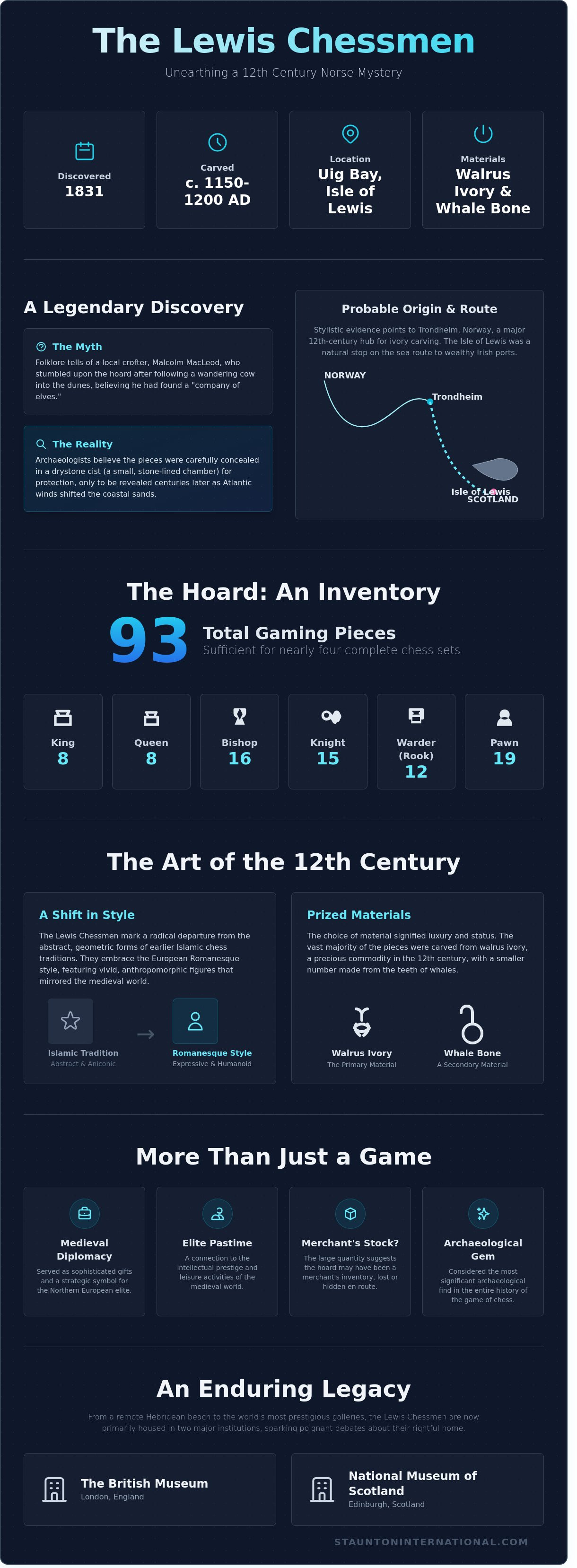
To look upon the lewis chessmen is to glimpse the very soul of medieval artistry. This remarkable hoard, comprising 93 individual gaming pieces carved from walrus ivory and whales' teeth, represents the most significant archaeological find in the history of the game. Dating back to the mid-12th century, these figures were unearthed in 1831 among the shifting sand dunes of Uig Bay on the Isle of Lewis. They offer a window into a time when the Kingdom of the Isles was a vibrant cultural crossroads, bridging the gap between the Gaelic world and the Norse seafaring empires. You might wonder how such an exquisite collection remained hidden for seven centuries; the answer lies in the volatile nature of the Hebridean landscape.
The discovery remains shrouded in a blend of historical fact and romanticised legend. The sheer volume of pieces suggests they were not a single set used for play, but rather a merchant's stock or a high-status gift. With enough pieces for nearly four complete sets, the hoard includes 8 kings, 8 queens, 16 bishops, 15 knights, 12 warders (rooks), and 19 pawns. Each figure possesses a distinct personality, from the wide-eyed astonishment of the warders to the contemplative posture of the queens. This variety speaks to a level of artisan dedication that mirrors the modern pursuit of perfection in heritage chess design.
Another factor worth considering is the intended destination of these treasures. Some historians believe they belonged to a merchant travelling from Scandinavia to the wealthy trading ports of Ireland. Others suggest they were the property of a Norse bishop, perhaps intended for a religious site like Iona. This mystery only adds to the allure of the pieces, cementing their status as masterpieces of functional art. They are not merely objects; they are a profound connection to the intellectual prestige of the medieval world.
Local folklore often paints a vivid picture of Malcolm MacLeod discovering the hoard after following a cow into the dunes. While the image of a crofter stumbling upon a "company of elves" is charming, the archaeological reality suggests the pieces were carefully concealed within a drystone cist. This small, stone-lined chamber protected the ivory for centuries until the Atlantic winds shifted the sands. Following their discovery, the pieces were sold by a local merchant, eventually finding their way to the British Museum and the National Museum of Scotland. This journey from a remote beach to the world's most prestigious galleries highlights the enduring value of meticulous craftsmanship.
The craftsmanship points directly to the workshops of 12th-century Trondheim, Norway. During this era, Trondheim was the seat of the Archbishop and a hub for high-status ivory carving. When you compare the intricate details of the lewis chessmen, such as the elaborate chair backs and the distinct facial expressions, to the stone carvings of Nidaros Cathedral, the stylistic parallels are undeniable. The Isle of Lewis served as a natural stopping point on the maritime route from Norway to Ireland. It was a logical place for such a valuable cargo to be cached during a period of political upheaval, preserving a legacy that continues to inspire connoisseurs today.
To understand the lewis chessmen, one must appreciate the radical departure they represent from the earlier, more abstract Islamic traditions that preceded them. Prior to the 12th century, playing pieces were largely geometric, following an aniconic tradition that avoided the representation of human or animal forms. The transition to the anthropomorphic Romanesque style seen here was a profound cultural shift. These figures didn't just represent pieces on a board; they were a vivid mirror of the medieval world, carved with a level of detail that suggests the work of a master artisan, likely in Trondheim, Norway, around 1150-1200 AD.
The choice of material was as significant as the carving itself. Of the 93 pieces discovered in the 1831 hoard, the vast majority were meticulously fashioned from walrus ivory, a luxury commodity of the era, while a smaller portion utilised cetacean bone. This ivory was prized for its dense grain and lustrous finish, allowing the carvers to achieve the intricate textures of chainmail and the subtle folds of ecclesiastical robes. You might wonder why the figures possess such "bewildered" or "anxious" wide-eyed expressions. Many historians believe these bulging eyes reflect the spiritual intensity and the strict social anxieties of the Middle Ages, where every individual held a fixed, often precarious, position within a rigid hierarchy.
The Kings of the hoard sit with a heavy, stoic posture, their hands resting on a broadsword laid across their knees. This isn't just a display of power; it's a symbol of the king as the ultimate judge and protector. In contrast, the Queen is perhaps the most enigmatic figure in the entire set. Her iconic "hand-to-cheek" gesture has sparked endless debate among scholars. Some interpret it as a sign of toothache or physical ailment, yet others see it as a gesture of deep contemplation or even the ritualised grief associated with the Virgin Mary.
This commitment to character and narrative depth is something we hold in high regard at Official Staunton. The way these ancient figures communicate their status through posture is a distant ancestor to the design philosophy found in our own Staunton reproduction chessmen. Just as the 12th-century carver laboured over the Queen's crown, our artisans focus on the precise proportions that have defined the game since 1849. If you appreciate this historical continuity, you might find that exploring our collection of antiqued patina chessmen offers a similar sense of timelessness.
The Warders, which we now recognise as rooks, provide a glimpse into the raw ferocity of Norse mythology. Several of these figures are depicted as berserkers, biting the tops of their shields in a state of pre-battle frenzy. This specific detail links the lewis chessmen directly to the Viking influence that still permeated the North Atlantic during this period. It's a striking, visceral image that stands in sharp contrast to the Bishops, who are shown in full liturgical vestments, often holding a crozier or a book.
The introduction of the Bishop as a powerful piece was a significant European innovation, replacing the earlier "alfil" or elephant from the Persian game. This change reflected the immense political and social influence of the Church in the 12th century. These expressive, individualistic figures are quite different from the later, more uniform aesthetic of the Morphy Series, which prioritised the mid-Victorian ideal of clinical precision and symmetry. While the Morphy sets offer a refined elegance, the Lewis pieces provide a raw, human connection to a world governed by sword and spirit alike.
To truly appreciate the lewis chessmen, one must look beyond their carved walrus ivory surfaces and view them as instruments of medieval statecraft. During the 12th century, these sets were far more than mere diversions; they functioned as miniature battlefields where the North European elite practised the cold logic of war and the delicate nuances of diplomacy. The discovery of the hoard in 1831 revealed a sophisticated world where the North Atlantic served as a bustling trade corridor, linking the artisan workshops of Trondheim to the remote reaches of the Outer Hebrides.
The game's immense popularity among the clergy and nobility highlights its role as a marker of intellectual prestige. It is fascinating to trace how the game adapted to Western sensibilities through linguistic and structural changes. For instance, the Persian "shāh" became the King, while the "alfil" or elephant was reimagined as the Bishop. This transition reflects a society that was actively projecting its own social and religious order onto the board, turning an Eastern pastime into a mirror of European feudalism.
The physical design of these pieces provides a direct link to the tactical realities of 12th-century combat. The Warders, for example, are depicted biting their shields, a clear reference to the legendary Berserkers of Norse sagas. This imagery reinforced the idea of the chess board as a training ground for real-world military engagement. Another significant evolution was the replacement of the "Vizier" with the "Queen." This change coincided with the rise of powerful female figures in European courts during the 1100s, such as Eleanor of Aquitaine, whose influence reshaped the political landscape. We take great pride in preserving this narrative through our about us commitment to design heritage, ensuring that the historical weight of each piece is never lost to time.
One might wonder why a merchant would carry such a vast quantity of ivory in a single chest. The presence of 93 individual pieces in the Lewis hoard, sufficient for at least four complete playing sets, suggests a commercial purpose. Some historians believe that several figures were actually intended for Hnefatafl, a traditional Norse strategy game. Unlike the balanced, two-sided conflict found in a standard playing set, Hnefatafl is a game of unequal forces. It involves a central King who must reach the safety of the board's edge while being pursued by a larger force of attackers. This crossover between different gaming traditions highlights the fluid cultural exchange that defined the medieval North Atlantic, where the lewis chessmen stood at the intersection of Norse tradition and emerging European customs.
A high-quality resin reproduction should feel cool to the touch, possessing a stone-like density that rewards the player every time a piece is moved. This physical weight is vital for "slow chess," where the deliberate act of lifting a heavy Warder or Queen encourages deeper reflection. The tactile nature of these pieces makes them as much a sculptural display as a functional game. To achieve this historic atmosphere in your own study, you might consider our Antiqued Patina Chessmen, which are crafted to evoke the exact look of weathered bone.
The footprint of these figures is notably different from modern sets. Most Lewis pieces feature wide, heavy bases that require a board with larger squares, typically 55mm or greater, to avoid a cluttered appearance. The aesthetic choice of wood is equally important. There is a striking visual harmony when the rustic, hand-carved textures of the Norse figures are set against the deep, polished grains of Walnut or Ebony. This contrast bridges the gap between the Viking Age and contemporary luxury design, ensuring the set remains a focal point of the room.
The 1831 discovery in the dunes of Uig Bay remains a pivotal moment in the history of the game. These 93 carved figures didn't just provide a glimpse into the 12th-century Norse world; they redefined our understanding of how medieval society viewed hierarchy and character. Every detail tells a story. Whether it's the wide-eyed stare of the warder or the contemplative pose of the queen, the artistry reflects a culture that valued both strategy and storytelling.
Owning a set of lewis chessmen isn't merely about acquiring a playing set; it's about preserving a connection to the craftsmanship of the High Middle Ages. You might find that the tactile experience of a high-quality reproduction changes how you approach the board. Our editions are based on the original 1831 hoard specifications to ensure every expression is captured accurately. Each piece features a hand-finished antiqued patina and is expertly weighted for a premium playing feel that commands respect during a match.
Explore our Isle of Lewis Chess Sets and bring a piece of 12th-century history to your home.
We hope this guide inspires you to look closer at these magnificent figures next time you sit down to play.
There are 93 individual pieces currently accounted for from the original hoard discovered in 1831 on the Isle of Lewis. The British Museum in London houses 82 of these treasures; while the National Museum of Scotland in Edinburgh curates the remaining 11. These figures represent the most significant collection of medieval gaming pieces ever found in the British Isles.
The wide eyes and pressed hands often interpreted as anxiety actually reflect a specific Romanesque artistic style from the late 12th century. These expressions likely symbolise alertness or a sense of spiritual awe rather than modern worry. You might notice how this gives each figure a distinct personality that feels remarkably human even after 800 years of history.
Master artisans carved the majority of the pieces from walrus ivory; although a small number were fashioned from whale teeth. These materials were incredibly valuable in the 12th century and suggest the set was intended for someone of immense status. The dense grain of the ivory allowed for the intricate detailing seen on the thrones of the kings and queens.
While they are arguably the most famous; the lewis chessmen are not the oldest pieces ever discovered. The Afrasiab set found in Uzbekistan dates back to the 8th century; making it several hundred years older than these 12th-century figures. However; the Lewis hoard remains the most complete and artistically significant medieval set known to history.
The figure biting its shield represents a berserker; a legendary Norse warrior known for fighting in a state of uncontrollable fury. This specific piece serves as a rook in the game and highlights the Viking influence on the islands during that period. It's a vivid detail that captures the raw intensity of medieval Scandinavian folklore and craftsmanship.
You can certainly enjoy a modern game using a replica lewis chessmen set; as many enthusiasts appreciate the weight and historical feel of these pieces. While they lack the streamlined geometry of a professional Staunton pattern; they provide a tactile connection to the game's ancient roots. Many collectors find that using these figures transforms a standard match into a more contemplative; artistic experience.
Historians generally believe the pieces were crafted in Trondheim; Norway; which was a major centre for ivory carving during the 1150 to 1200 period. Some scholars even point to a specific artisan named Margret the Adroit; an Icelandic carver known for her exceptional skill. The uniform quality across the 93 pieces suggests a workshop of highly disciplined masters rather than a lone individual.
The Isle of Lewis set shares no direct design lineage with the Staunton pattern; which was famously registered in 1849 by Nathaniel Cook. The Lewis pieces are figurative and representational; whereas the Staunton design was created for clarity and durability in competitive play. Despite these differences; both styles are celebrated by Official Staunton as essential milestones in the evolution of the game's aesthetic heritage.
